
 thesiswriter.pk@gmail.com |
  +92 3164838761
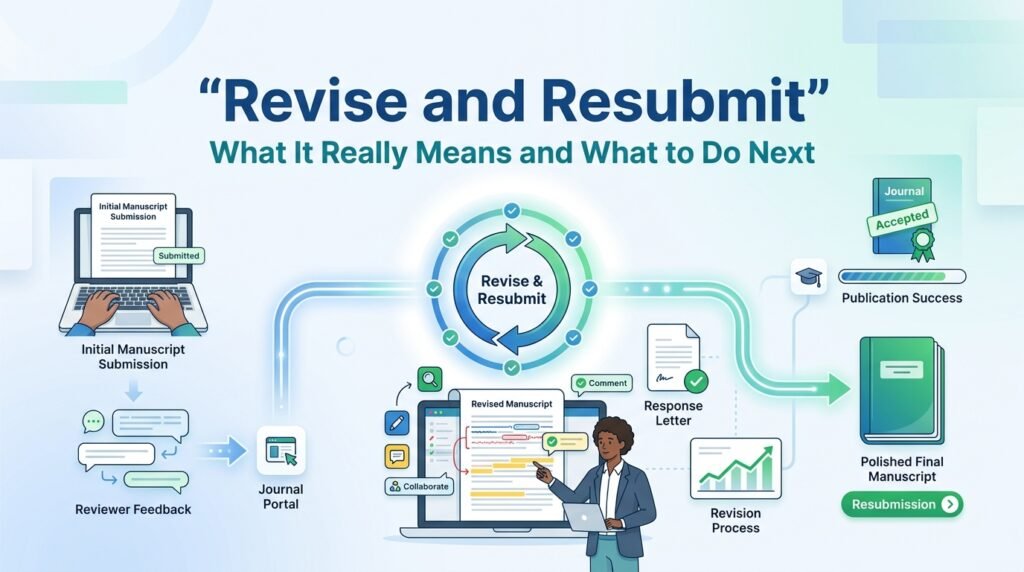
Revise and Resubmit: What It Really Means and What to Do Next
Short answer: a revise-and-resubmit (R&R) is a conditional yes — the editor is telling you the paper can be published in this journal if you do specified work. It is the strongest positive signal most manuscripts ever receive before acceptance, and the correct emotional response is relief, not despair. This guide covers what the decision means in editorial practice, how to read the letter, your realistic odds, the six-step response process, and the mistakes that convert conditional yeses into final nos.
What R&R actually is
Journals decide on a spectrum, and R&R sits decisively on its favorable half. When an editor issues a revision decision instead of a rejection, they are investing: their time to re-handle the paper, reviewers’ time to re-read it, and the journal’s slot pipeline on the expectation of eventual publication. Editors do not make that investment in papers they expect to fail — desk rejection exists precisely so they don’t have to. A major revision with harsh-sounding reviews and an R&R at the end is, structurally, a better outcome than a kind rejection: the harshness is the specification of the remaining work, and the R&R is the contract that doing it matters.
| Decision | Editorial meaning | Typical outcome if handled well |
| Minor revision | Substance approved; polish specified | Acceptance, often without re-review |
| Major revision (R&R) | Conditional yes with substantive conditions | Acceptance after 1–2 further rounds — the modal path for published papers |
| Reject & resubmit | Current version closed; a substantially new version invited | Treated as a fresh submission with a head start |
| Reject with reviews | This journal is done; the analysis travels with you | Re-target using the reviews (see our rejection-reasons post) |
| Desk reject | Not entering review — usually scope or formalities | Fix the match, not necessarily the paper |
Your real odds — and why authors misread them
Authors consistently underestimate post-R&R success because they read reviewer tone as a verdict. The structural reality: most papers that eventually appear in selective journals — where overall acceptance commonly runs 10–40% — passed through at least one major revision on the way, making R&R-then-acceptance the modal biography of a published paper, not the exception. Once a journal issues an R&R, the population your paper competes in has changed: it is no longer one submission among all comers, but one of the minority the editor has already chosen to invest in. Conversion from that position depends overwhelmingly on response quality — which is the one variable entirely in your hands.
Reading the letter: three signals to extract
- The editor’s own paragraph. Editors often synthesize: “pay particular attention to Reviewer 2’s concerns about the sampling frame.” That sentence is the priority list — the editor is telling you which conditions are load-bearing.
- The distribution of comment types. Sort comments into presentation (clarity, structure, reporting), analysis (additional tests, robustness), and design (sampling, measurement, data). Presentation and analysis comments are fully addressable in revision; design comments need honest handling — addressed within your data’s limits, acknowledged as limitations where they can’t be, argued with evidence where they misread the design.
- The re-review plan. Letters often state whether the revision returns to reviewers or to the editor alone — which calibrates how self-contained and locatable your response letter must be (fully, in both cases, but the audience differs; our reviewer-response guide covers the letter itself).
What happens at the journal after you resubmit
Demystifying the pipeline calibrates the response. Your revision lands with the handling editor, who makes a routing decision: minor revisions are often assessed editorially and accepted without further review — meaning a complete, well-located letter can end the process in days; major revisions typically return to the original reviewers, who receive your letter alongside the manuscript and, being human, check their own comments first. Reviewers then recommend; the editor decides — including, routinely, overruling a lone holdout when your response gave them the evidence to do so. Every tactical rule in this guide follows from that pipeline: the letter is read first and sometimes alone, reviewers audit their own points before anything else, and the editor is an arbiter who can be equipped. Write for that machine and the machine works for you.
The six-step response process
- Cool off for 48 hours. Read the decision once, close it, return in two days. First readings overweight tone and underweight the R&R itself; second readings find the conditional yes.
- Triage every comment. Quick fixes · substantive-but-doable · contestable — with an hours estimate per bucket. The estimate versus the deadline tells you today whether to request an extension (early, with a specific date; editors grant reasonable asks routinely).
- Plan analyses before prose. New tests and robustness checks gate everything else — run them first, because their results may reshape the revision. If a requested analysis is beyond your current skills, that’s a coachable gap, not a wall: reviewers ask for standard procedures, and standard procedures are learnable on your own data in a session or two.
- Revise the manuscript, tracking everything. Make the changes with tracked changes or marked color, keeping a change log as you go — the log becomes the spine of the response letter.
- Write the point-by-point letter. Every comment, numbered, quoted, answered, located. Change first, argue second; disagree with evidence, not adjectives. (Full template in our reviewer-response guide.)
- Audit and resubmit ahead of the deadline. Verify the manuscript contains every change the letter claims, re-check the journal’s formatting on any new material, and submit with days to spare — deadline-minute submissions correlate with the errors reviewers notice first.
Worked example: a hostile-sounding R&R, converted
A composite from resubmission-support work. The decision letter: major revision, three reviewers, forty-one comments, and a Reviewer 2 whose opening line called the framing “conceptually confused.” The 48-hour rule applied, triage found the real shape: twenty-six presentation comments (one weekend), eleven analysis requests — nine standard robustness checks plus two requiring a technique the author hadn’t run (two coached sessions on her own dataset) — and four genuinely contestable points, of which the author conceded two and contested two with citations and a new limitation paragraph. The “conceptually confused” opener, on second reading, resolved into one fixable issue: the introduction promised a theory-testing paper while the discussion delivered a theory-extending one; aligning them took a day and dissolved a dozen downstream comments. Resubmitted in week seven of a twelve-week window with a nine-page response letter; accepted after one further minor round, eleven weeks later. The pattern to steal: harsh language usually compresses into few load-bearing issues, and volume of comments predicts effort, not outcome.
Why R&R feels worse than it is
Two cognitive effects distort the first reading. Negativity dominance: forty supportive-neutral sentences and six critical ones read as a hostile document, because criticism from experts about work that carries your identity lands with force — which is precisely why the 48-hour rule exists, and why experienced authors read decision letters twice with different selves. And tone-outcome conflation: reviewer harshness correlates poorly with editorial intent — the decision line, not the adjectives, is the verdict, and the decision line says revise. Rebase on the structural fact: the editor invested; the conditions are enumerated; the remaining variable is your response.
The four ways authors lose an R&R
- Cosmetic compliance: softening a sentence where the reviewer asked for an analysis — reviewers check their own comments first, and detected evasion converts a supporter into an opponent.
- Combat mode: treating the response letter as a rebuttal brief — winning arguments and losing the paper. The letter’s job is to make accepting easy, not to establish who was right.
- Scope creep: using the revision to add everything the paper “should have had” — new sections nobody requested invite new objections nobody anticipated. Revise to the comments; save the rest for the next paper.
- The silent deadline slide: letting the window lapse without contact — at many journals an expired R&R quietly becomes a withdrawal, converting your strongest signal into a fresh submission somewhere else.
Language quality in the revision round
New and rewritten passages enter the second round unedited unless you edit them — and reviewers notice quality drops between the polished original and hurried additions. Budget a language pass over every changed section before resubmission; where the journal raised language at round one, an editing certificate with the revision closes that comment permanently.
R&R under a graduation deadline
For readers publishing against a viva or graduation date — standard across Malaysian doctoral programs — an R&R changes your planning math favorably: you are now one good response and one editorial cycle from acceptance, typically four to eight weeks of decision time after your revision lands. Protect that position: triage on day one, request any extension immediately rather than optimistically, and treat the response letter as the highest-stakes document of your candidature — because at that moment, it is.
Don’t fumble the minor revision
Minor revisions deserve a paragraph precisely because authors relax into errors. The decision means the substance has passed — which makes unforced errors the only remaining threat. The standard fumbles: introducing new mistakes while polishing (every fresh sentence is unreviewed prose — keep late edits surgical); silently rewriting sections nobody questioned (reviewers re-read diffs; unexplained changes reopen closed questions); and treating the response letter as optional because the changes are small (completeness standards don’t scale down — every comment still gets its numbered, located reply). Handle a minor revision with major-revision discipline compressed into a week, and the next email is typically the acceptance.
The takeaway
Revise-and-resubmit is the publication system working as designed: expert specification of the distance between your manuscript and print, plus an editor’s commitment that closing it matters. Read the letter structurally, triage before drafting, run the analyses first, track everything, answer everything, and protect the deadline — and the modal outcome of the modal path is the one the statistics already predict: acceptance, one or two rounds out.
FAQs
Can a paper still be rejected after R&R? Yes — conversion is likely, not guaranteed, and the failure modes above account for most losses. The protective factors are completeness, tone, and evidence, in that order.
How many revision rounds are normal? One major round followed by a minor round is the common pattern; two major rounds happen at demanding journals. A third major round is rare and usually signals an editor keeping a struggling paper alive — take it seriously and respond completely.
Is “reject and resubmit” worth doing? Usually yes, if the required rework aligns with what you believe the paper should be — you inherit informed reviewers and a receptive editor. If the demanded version isn’t a paper you want to write, take the reviews to a better-fitting journal instead.
Should co-authors divide the response? Divide the revisions by expertise, but give the letter one owning voice — stitched responses read unevenly, and inconsistencies between sections are exactly what reviewers notice. One author drafts the full letter; all authors audit it against the manuscript.
The revision demands new data collection — is that reasonable? Sometimes. Distinguish three cases: additional analysis of existing data (standard — do it); a modest supplementary sample to patch a specific gap (judgment call — weigh feasibility against the journal’s value and say what you decided and why); and a redesigned study (that’s not a revision — respond honestly that the request exceeds the current study’s scope, address the underlying concern via limitations and tempered claims, and let the editor arbitrate). Editors respect scoping honesty far more than heroic promises that miss the deadline.