
 thesiswriter.pk@gmail.com |
  +92 3164838761
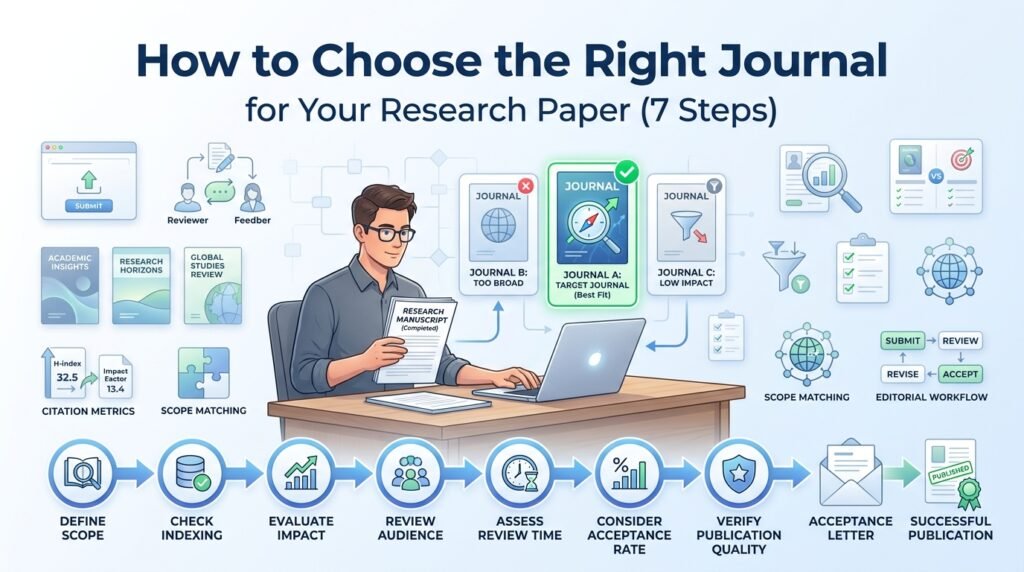
How to Choose the Right Journal for Your Research Paper (7 Steps)
Journal choice is the highest-leverage decision in the publication process: get it right and everything downstream — review speed, acceptance odds, and whether the publication even counts for your requirement — improves; get it wrong and the typical cost is a full review cycle of three to six months per mistake. Yet most researchers choose by folklore: the journal their supervisor names, the highest-ranked title in the field, or whichever venue emailed them last week. This guide replaces folklore with a seven-step method — the same sequence our consultants use to build client shortlists — ending with a scoring matrix you can apply in an afternoon.
Why this deserves a formal method
Consider what the informal alternative costs. Every mismatched submission burns a full cycle — one to four weeks to a desk rejection at best, the full 8–18 week review wait at worst — and published papers commonly survive two to four submissions even when well targeted. Folklore selection stacks avoidable cycles on top of unavoidable ones: the prestige-first ladder donates months to journals that were never going to say yes, while the invitation-driven shortcut hands manuscripts to the predatory funnel our checklist post documents (20,000+ flagged journals and counting). A one-afternoon method that removes even one wrong submission repays itself in a season of calendar time — and unlike review outcomes, journal choice is a variable you control completely.
Step 1: Start from the requirement, not the journal
Before looking at a single journal, write down the rule you are publishing under, verbatim. “Scopus-indexed” is a different rule from “ISI-indexed,” which is different again from “Q1 by JIF” or “indexed journal recognized by the faculty.” Doctoral regulations, promotion frameworks, and scholarship conditions specify these precisely, and the difference decides your candidate pool before fit even enters the conversation — our Scopus vs Web of Science guide unpacks exactly what each phrasing includes and excludes, including the ESCI trap that catches researchers whose rule silently assumes an Impact Factor. If no formal rule binds you, your requirement is strategic instead: the recognition your next career step’s committee will apply.
Step 2: Build the candidate list from where your paper already lives
The best candidate journals are hiding in your own reference list — the venues you cite most are, definitionally, hosting your conversation. Add to that: publisher journal-finder tools (Elsevier, Springer, Wiley, and Taylor & Francis all offer free matchers that read your title and abstract), the “published in” fields of the five papers closest to yours, and — for Malaysian requirements — the MyCite listings for locally recognized options. Target eight to twelve candidates at this stage; fewer means you’re anchoring, more means you’re procrastinating.
Step 3: Screen before you rank
Screening removes journals that fail absolute conditions; ranking compares the survivors. Screen every candidate for: current indexing verified at source (the Master Journal List and Scopus Sources list, including the discontinued tab — delisted journals’ new articles don’t count); predatory signals via our 12-point checklist and Think. Check. Submit.; and requirement compliance from Step 1. Expect the screen to remove a quarter to half of a folklore-built list — that’s the screen working, and every removal is a three-to-six-month detour you didn’t take.
Step 4: Score scope fit — the factor that actually predicts acceptance
Fit is testable, not vibes. For each surviving candidate, run three checks. The citation test: how many of your references come from this journal? (Several is a strong signal; zero is close to disqualifying.) The table-of-contents test: read the last two years of issues — has the journal published your kind of question, method, and data recently? The conversation test: can you name two recent papers in the journal that your manuscript directly extends or challenges? A paper that passes all three gets desk-reviewed by an editor who recognizes it, reviewed by referees who care about it, and read by an audience that cites it.
Step 5: Weigh the practical factors
| Factor | What to check | Where |
| Review speed | Published time-to-first-decision; medians beat marketing claims | Journal homepage; publisher journal finders |
| Acceptance selectivity | Reported acceptance rate, where available (commonly 10–40% at selective titles) | Journal/publisher statistics pages |
| Open access & cost | APC amount, waivers, and whether OA is required by your funder | Journal’s OA page; funder policy |
| Word/format limits | Does your paper fit without amputation? | Author guidelines |
| Audience reach | Who actually reads it — academics, practitioners, region | Aims & scope; recent citing literature |
| Quartile & metrics | JIF or CiteScore quartile under YOUR rule’s system | JCR / Scopus source page |
No journal wins every row. The method is to weight rows by your situation: a doctoral candidate against a viva deadline weights speed and requirement compliance; a promotion case weights quartile; an unfunded author weights APC — waivers and diamond OA (no-fee) options included.
Step 6: Rank with a simple matrix
Score each surviving journal 1–5 on four dimensions — requirement compliance (gate: must be 5), scope fit (from Step 4’s three tests), practicality (speed, cost, limits, weighted for your situation), and recognition (quartile or standing under your rule’s system). Sum, rank, and keep the top three to five as your ordered submission ladder: first choice plus pre-planned alternates, so a rejection triggers a same-week resubmission to a screened journal instead of a month of fresh dithering. Write the ladder down before the first submission — decisions made before rejection are calmer than decisions made after.
Step 7: Confirm with a pre-submission inquiry where offered
For your top choice, check the author guidelines for a pre-submission inquiry option: a two-paragraph email — abstract plus fit rationale — that many editors answer within days. A “not for us” by email costs a week; the same answer by desk rejection costs a month or more. Where the option doesn’t exist, your cover letter carries the fit case instead: contribution, fit, and the two closest recent papers in the journal, in half a page.
Worked example: the matrix on a real-shaped shortlist
A composite from client work — a technology-adoption survey paper, author bound by a “Scopus-indexed, Q2 or better by CiteScore” promotion rule. Twelve candidates from Step 2; the Step 3 screen removes four (one WoS-only ESCI title failing the CiteScore rule, one delisted two years ago, two failing predatory screening — both, naturally, the ones that had emailed). The matrix on the survivors’ top four:
| Journal (anonymized) | Requirement (gate) | Scope fit /5 | Practicality /5 | Recognition /5 | Total |
| A — field flagship | 5 | 3 (adjacent, methods-heavy) | 2 (slow; 9,000-word ceiling) | 5 | 15 |
| B — regional specialist | 5 | 5 (cited 7× in the draft) | 4 (published medians; fair APC) | 4 (solid Q2) | 18 |
| C — broad OA title | 5 | 3 (publishes everything, converses about nothing) | 5 (fast; low APC) | 3 | 16 |
| D — adjacent-discipline journal | 5 | 4 | 3 | 4 | 16 |
Journal B wins on the dimension that predicts acceptance — fit — despite flagship A’s prestige and C’s convenience; the ladder becomes B → D → C, with A held for the follow-up paper actually shaped for it. Notice what the matrix did: it surfaced a defensible disagreement with instinct (which said A) and pre-committed the alternates before rejection could distort judgment.
Special situations
- Interdisciplinary papers: run the fit tests per home discipline — the journal where your reference list lives usually beats the journal where your topic sounds like it belongs; a bridging paper needs an audience, not a category.
- Replication and null-result studies: screen for journals that explicitly welcome them (registered reports, sound-science venues) — fit here includes editorial policy, not just topic.
- Regional vs international targets: a strong MyCite-indexed Malaysian journal can be the rational choice where the requirement permits it and the audience is regional — requirement compliance and readership are the tests, not geography prestige.
The mistakes this method prevents
- The prestige ladder: submitting top-down by rank regardless of fit — each wrong rung costs a review cycle, and the eventual acceptance lands where fit analysis would have started.
- The email-invitation shortcut: choosing whichever journal solicited you — solicitation is a predatory tell, not a selection method.
- The screenshot check: trusting a two-year-old indexing claim — verification is at-source and current, or it isn’t verification.
- The single-target plan: no ladder means every rejection restarts the entire selection process under worse morale.
Reading a journal like an editor: five in-page signals
Beyond the matrix, the journal’s own pages carry signals the databases don’t. Editorial board currency: active scholars in your subfield on the board means competent handling for your paper — spot-check three names as you would in predatory screening, but now for relevance rather than existence. Special issue ratio: a journal publishing mostly special issues has outsourced its editorial judgment; a moderate ratio is normal, dominance is a caution light. Reference behavior: do the journal’s recent papers cite the current international conversation, or mostly the journal itself? Heavy self-citation flags both quality and, occasionally, metric management. Turnaround honesty: journals that publish submission-received-accepted dates on articles are showing you real timelines — read five recent papers’ dates and you have a better speed estimate than any marketing claim. And author geography: a genuinely international author mix signals the audience your paper will actually reach. Fifteen minutes of reading per finalist, and the matrix’s recognition and practicality rows fill themselves with evidence.
The takeaway
Journal selection rewards the same discipline as research itself: explicit criteria, verified data, and pre-committed decisions. Requirement first, candidates from your own reference list, screening before ranking, fit scored by evidence, practicalities weighted to your situation, a written ladder, and an inquiry where offered — an afternoon’s work that routinely saves a season of calendar time and, for deadline-bound candidates, sometimes the deadline itself.
FAQs
Should I aim high on the first submission? Aim high within fit. The top journal that genuinely hosts your conversation is a rational first rung; the top journal, full stop, is a donation of three months. The scoring matrix makes the difference explicit.
How much should APC matter? As a practical row, not a quality signal in either direction — excellent journals span free-to-publish and four-figure APCs, and so do terrible ones. Check waiver eligibility (many publishers discount by country) and diamond OA options before ruling anything out on cost.
My supervisor insists on a journal that fails the fit tests. What now? Show the evidence, not the disagreement: the citation count from that journal in your references, the two-year contents scan, and your matrix. Supervisors reason from experience; matrices update experience. If the answer is still that journal, one submission there is a cycle you can afford — with the ladder pre-agreed for round two.
How often should I redo the verification? At submission time, every time — indexing and quartiles move annually, and delistings arrive mid-year. The ladder you built last spring needs a ten-minute re-screen before each rung is used, which is also why we date-stamp every verification in client shortlists.
Do publisher journal-finder tools choose well? They generate candidates competently — text-matching your abstract against journal scopes — and rank naively, because they weight their own publisher’s titles and know nothing about your requirement, your deadline, or predatory risk. Use them at Step 2, never as the whole method: the screen, the fit tests, and the matrix are precisely the judgment they don’t apply.