
 thesiswriter.pk@gmail.com |
  +92 3164838761
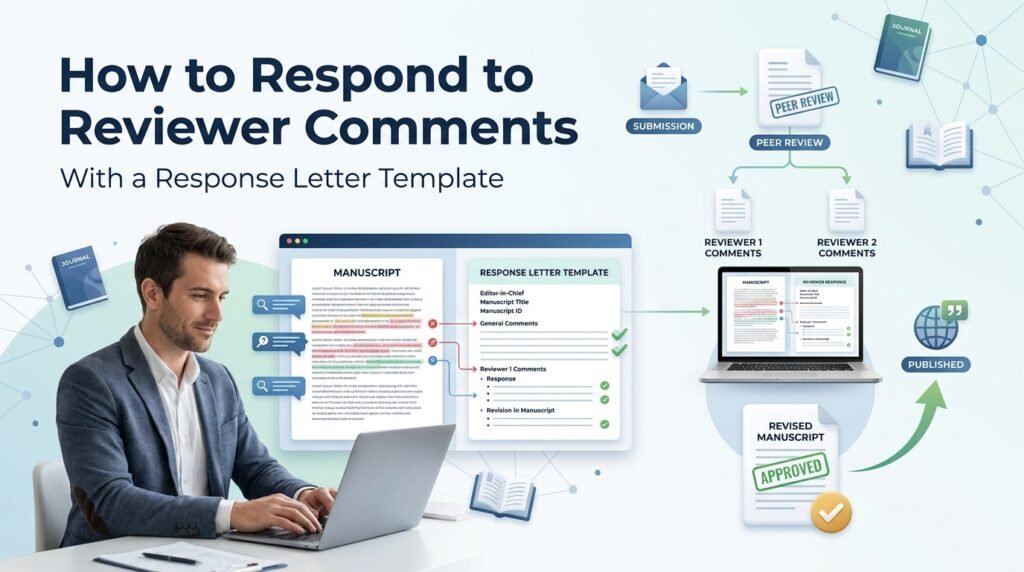
How to Respond to Reviewer Comments (With a Response Letter Template)
A “revise and resubmit” is not a polite rejection — it’s the editor telling you the paper can make it if you handle the response well. Most published papers went through at least one revision round. This guide gives you the decision-letter decoder, the five rules of response, worked examples for the three hard situations, and a copyable point-by-point template — everything between you and a strong resubmission.
First: know which decision you’re holding
| Decision | What it actually means | Your move |
| Accept / accept with minor changes | Rare on first submission; the paper is in | Complete the minor edits fast and flawlessly |
| Minor revision | Reviewers are satisfied with substance; fixes are cosmetic-to-moderate | Full point-by-point response; aim to close in one round |
| Major revision | The paper is alive but something substantive must change | The full process in this guide — this is the make-or-break letter |
| Reject & resubmit | Too far for revision tracking, but the journal wants it back | Treat as major revision plus a fresh-eyes restructure |
| Reject (with reviews) | This journal is done; the reviews are free consulting | Fix what’s right in the comments, then re-target (see our journal selection guide) |
Everything below assumes minor or major revision — the decisions where the response letter, not the manuscript alone, determines the outcome.
Why the letter decides your paper’s fate
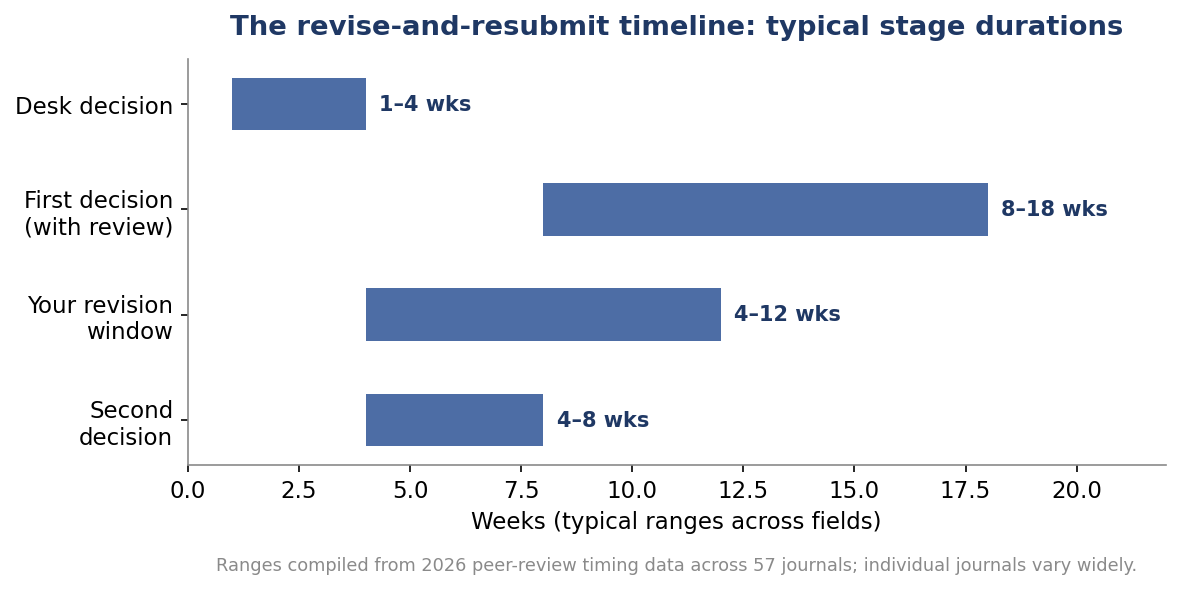
Figure 1. Typical stage durations in the review cycle. A failed second round doesn’t just reject the paper — it costs the entire timeline again at a new journal.
Look at the arithmetic of the chart. First decisions commonly take 8–18 weeks depending on field; desk rejection alone claims 15–90% of submissions at individual journals. Holding a revise-and-resubmit means you’ve outlasted most of the field — and a botched response letter throws that position away. Reviewers who feel ignored, or contradicted without evidence, recommend rejection in round two; editors who receive disorganized responses send papers back out for full re-review instead of accepting directly. The letter is the single document that controls which of those happens.
The reviewer-language decoder
Reviewers write in a dialect of academic politeness. Here’s the translation table we use with clients:
| What the reviewer wrote | What it means | Required response level |
| “The manuscript would benefit from…” | Do it | Make the change |
| “The authors may wish to consider…” | Do it, or decline with evidence | Change or justified refusal |
| “It is not clear to this reviewer why…” | Your writing failed to justify a choice | Rewrite the justification in the manuscript, not just the letter |
| “The contribution of the study is unclear” | The introduction is not doing its job | Reframe — this is the most common substantive comment in existence |
| “Some relevant literature appears to be missing (e.g., …)” | Often: cite these; occasionally: cite me | Add what’s genuinely relevant; you may decline self-citation pressure politely |
| “I leave this to the editor’s discretion” | The reviewer is unconvinced but won’t die on this hill | Address it anyway — cheaply won goodwill |
Before you write: triage the comments
Resist drafting responses in the order comments arrive. First pass: sort every comment into three buckets — quick fixes (typos, citation formats, clarity tweaks: batch them in an afternoon), substantive-but-doable (new robustness checks, restructured sections, added literature: these define your real timeline), and contestable (points where you may refuse with evidence: cap these at the genuinely defensible few). Estimate hours per bucket before you touch the manuscript; the estimate tells you immediately whether the deadline is realistic and, if not, gives you the specifics for an early extension request. Authors who triage first also spot the pattern comments — three reviewers circling the same unclear methods paragraph from different angles is one fix, not three.
The five rules
- Answer everything. Every comment gets a numbered response — the painful ones, the trivial ones, the compliments. Silence on any point reads as evasion, and reviewers check.
- Quote, respond, locate. Reproduce each comment verbatim, state your action, and give the exact page and line of the change. A reviewer who has to hunt for your revisions starts the second read irritated.
- Change first, argue second. Where a change is reasonable, make it — even if you’d have phrased it differently. Bank your credibility for the disagreements that actually affect the paper’s claims.
- Disagree with evidence, not adjectives. The acceptable form: “We respectfully retain X because [data/citations]. We have added a limitation acknowledging this concern at p. Y.” You’re allowed to disagree — editors expect it — but you must hand the editor something concrete to arbitrate with.
- Thank without groveling. One genuine sentence at the top. Reviewers read a great deal of insincere gratitude; professionalism outperforms flattery.
Worked examples: the three hard situations
Situation 1 — the reviewers contradict each other. Reviewer 1 wants the theory section expanded; Reviewer 2 wants the paper shortened. Response pattern:
“We note that Reviewer 1 recommends expanding the theoretical framing while Reviewer 2 recommends condensing the manuscript. We have expanded the theoretical justification for H2–H3 (pp. 6–7, +420 words) as we judged this central to the contribution, and offset it by condensing the descriptive statistics discussion (pp. 11–12, −380 words). We flag this trade-off for the editor’s judgment.”
This works because it acknowledges both reviewers, makes a reasoned choice, quantifies it, and explicitly invites arbitration — which is the editor’s job, and they know it.
Situation 2 — a comment demands analysis you don’t know how to run. Never pretend the comment isn’t there, and never bluff a method. Either learn to run it (a robustness check in SPSS or R is usually a coachable afternoon, not a semester — see the CTA), or do what genuinely addresses the underlying concern and say so:
“The reviewer suggests a multilevel specification. Our sample of 214 respondents across 9 firms provides insufficient level-2 units for a stable multilevel model (guidance commonly suggests 20+ clusters). We have instead added firm fixed effects and clustered standard errors (Table 4, Model 3), which address the nesting concern within our data’s limits, and we note the multilevel extension as future research (p. 18).”
Situation 3 — the reviewer is simply wrong. It happens. First check whether your own unclear writing caused the misreading — that is the more common truth, and the fix is a manuscript clarification, not a correction. If the reviewer is genuinely mistaken:
“We believe there may be a misunderstanding regarding the sampling frame: as noted on p. 8 (now clarified further), respondents were screened for procurement responsibility, so the concern about general-population sampling does not apply. We have revised the Methods paragraph to prevent this misreading.”
One correction, sourced to the manuscript, wrapped in a clarity improvement. Never score points; reviewers vote on round two.
Timeline management
Revision windows typically run 4–12 weeks (Figure 1). Two rules: if the required work genuinely exceeds the deadline — new data, a substantial re-analysis — request an extension early, with a specific date; editors grant reasonable requests routinely and resent last-minute ones. And never let the deadline pressure you into partial responses: an incomplete letter that ignores hard comments performs worse than a two-week extension.
What the editor does with your response
Knowing the process changes how you write. When your revision arrives, the handling editor makes a routing decision: for minor revisions, many editors assess the response themselves and accept without further review — which means a complete, well-located response letter can end the process that week. For major revisions, the default is returning the package to the original reviewers, who receive your letter alongside the revised manuscript and typically check their own comments first. Two implications: the letter is often read before the manuscript, so it must stand alone; and the fastest route to acceptance is making the re-review effortless — every claim locatable, every change visible, nothing left for a reviewer to hunt for or wonder about.
Formatting the response document
- Use a consistent structure: reviewer number → comment number → verbatim comment (italic or quoted) → your response → location of change. Some authors use a three-column table (comment / response / location); prose with clear numbering works equally well — consistency matters more than format.
- Distinguish text visually: reviewer comments in italics, responses in roman, quoted manuscript changes in a different color — announced once at the top (“revisions appear in blue”).
- Respect anonymity: for double-blind journals, keep identifying details out of the response copy reviewers will see; some journals request a separate anonymized version.
- Keep a change log: a short summary table of major changes at the top of the letter (what changed, where, in response to whom) lets the editor grasp the revision in thirty seconds — disproportionately valuable when your revision is heavy.
Tone calibration: phrases that work and phrases that sink you
| Avoid | Use instead |
| “As we already stated in the manuscript…” | “We have clarified this point at p. X to make the rationale explicit.” |
| “The reviewer misunderstood…” | “We believe a misreading may have arisen from our phrasing; we have revised…” |
| “We strongly disagree.” | “We respectfully offer evidence for retaining this approach: [citations/data].” |
| “This is beyond the scope of our paper.” (alone) | “This falls outside the present study’s design; we now acknowledge it as a limitation (p. X) and a direction for future research.” |
| “Thank you for this excellent, insightful, brilliant comment.” (every time) | One genuine thank-you at the top; substance thereafter. |
The template (copyable)
Dear Editor, — We thank you and the reviewers for the constructive assessment of our manuscript [ID]. We have revised the manuscript in response to all comments; changes are marked in [tracked changes/color]. Our point-by-point responses follow.
REVIEWER 1, Comment 1: “[quote the comment in full]”
Response: We agree and have [specific change]. See p. [X], lines [Y–Z].
REVIEWER 1, Comment 2: “[quote]”
Response: We respectfully retain [element] because [evidence, citation]. To address the underlying concern we have added [change] at p. [X].
[Number every comment, grouped by reviewer. Close:] We believe the manuscript is substantially strengthened by these revisions and hope it now meets the standard for publication in [Journal]. — [Authors]
The 10-minute pre-submission audit
- Every comment has a numbered response with a manuscript location
- Tone pass: zero sarcasm, zero apology spirals, every disagreement evidenced
- The revised manuscript actually contains every change the letter claims (editors check)
- Word/format limits still met after additions
- Deadline confirmed — extension requested early if needed
- A colleague or professional has read the letter cold for tone and completeness
FAQs
Do I have to do everything the reviewers ask? No — you have to respond to everything. Well-evidenced, respectful refusals on genuinely contestable points are a normal part of the process; wholesale compliance that damages the paper serves nobody. The ratio matters: a letter that refuses half the comments signals a fight the editor won’t referee in your favor.
What if I can’t meet the revision deadline? Email the editor early with a specific new date and a one-line reason. Editors grant reasonable extensions routinely; unexplained silence past a deadline can convert your revise-and-resubmit into a withdrawal.
Should I ever contact the editor about a hostile review? If a review is abusive (not merely harsh), a brief, professional note to the editor is appropriate. If it’s harsh but substantive, answer the substance — winning the second round is the better rebuttal.