
 thesiswriter.pk@gmail.com |
  +92 3164838761
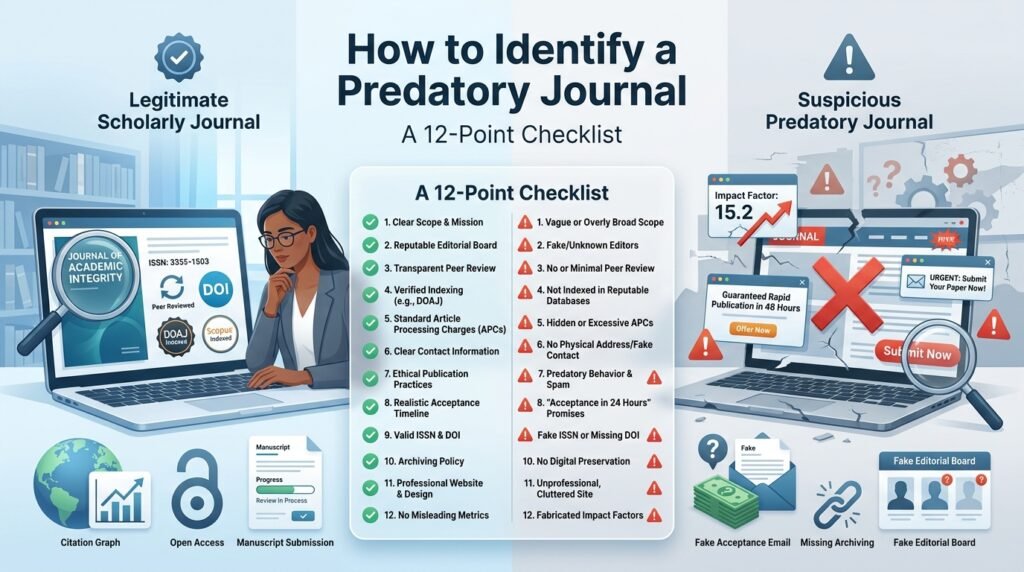
How to Identify a Predatory Journal: A 12-Point Checklist
Predatory journals take your money, skip real peer review, and leave you with a publication that can be worse than none: unusable for graduation or promotion, and unresubmittable elsewhere because the work counts as published. The problem is not fringe — the numbers below show an industry — and researchers under publication deadlines in Malaysia and the Gulf are among its primary targets. This post gives you the scale, the economics, a 12-point checklist, an annotated scam invitation, and the exact verification steps that take five minutes per journal.
The scale, in verified numbers
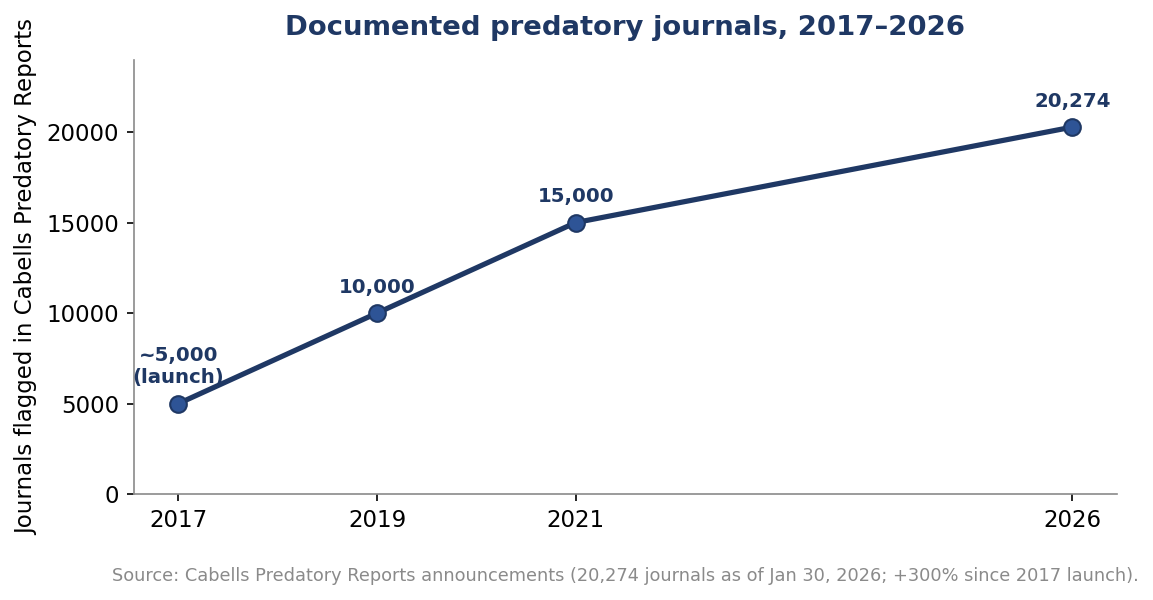
Figure 1. Growth of Cabells’ Predatory Reports database — the largest curated list of deceptive journals.
Cabells’ Predatory Reports — the subscription database that evaluates journals against 70+ documented criteria — passed 20,000 flagged titles in early 2026 (20,274 as of January 30), after reaching 10,000 in 2019 and 15,000 in 2021: growth of over 300% since the database launched in 2017. Independent academic estimates found the problem at scale years earlier: Shen and Björk’s 2015 study in BMC Medicine estimated roughly 10,000 predatory journals publishing hundreds of thousands of articles per year, and a 2019 Nature comment noted that Cabells’ list of suspected predatory journals (10,406 at the time) had grown larger than its list of verified legitimate ones (10,077). Recent compilations put output from non-peer-reviewed outlets at around 420,000 articles annually. This is an industry with revenue, marketing, and a sales funnel — and its funnel starts in your inbox.
Why predatory journals exist (know the economics, spot the scam)
The open access model, used honestly, charges authors an article processing charge (APC) to make research free to read — and legitimate OA journals earn that fee with real peer review, editing, indexing, and preservation. The predatory model keeps the APC and deletes the costs: no meaningful review (sting operations have repeatedly gotten nonsense papers accepted), no editing, fabricated metrics, and indexing claims that dissolve on checking. Their acceptance rate is their business model. Once you see that the product being sold is acceptance itself, every red flag below becomes predictable.
Legitimate vs predatory: the tell-by-tell table
| Signal | Legitimate journal | Predatory journal |
| Peer review time | Weeks to months; 8–18 week first decisions typical | “48–72 hours”; “guaranteed acceptance” |
| Indexing claims | Verifiable in Scopus Sources / Master Journal List | Badge walls that fail source checks |
| Metrics | JIF (Clarivate) or CiteScore (Scopus) | “Global/Universal Impact Factor,” invented indices |
| APC disclosure | Published openly before submission | Revealed after acceptance; negotiable by email |
| Scope | Defined field | “Science, Management, Humanities & Technology” in one title |
| Editorial board | Named, affiliated, verifiable scholars | Unverifiable names — or real ones listed without consent |
| Ethics policies | COPE-aligned retraction/misconduct policies | Absent or boilerplate |
| Solicitation | Rarely emails authors for papers | Mass flattery emails inviting submission |
Anatomy of the invitation email
Nearly every predatory relationship starts with an email like this. Annotated:
“Dear Esteemed Professor [wrong name], — We read your recent paper [title scraped from another journal] with great interest [flattery, no substance]. We cordially invite you to submit to our reputed journal IJARSMHT [absurd scope acronym], ISI Impact Factor 7.2 [fake metric — ISI no longer issues impact factors], indexed in Google Scholar, ResearchGate [not indexes], with rapid publication within 5 days [no review] at a discounted fee of $199 if submitted within 48 hours [urgency pricing].”
Flattery, fake metrics, non-indexes presented as indexes, speed, and countdown pricing — five tells in four sentences. Legitimate journals do almost none of these things, and never all of them.
The 12-point checklist
One or two flags deserve investigation; three or more means walk away.
- Unsolicited invitation. The journal recruited you by email with generic praise. Legitimate journals rarely solicit; predatory ones almost always do.
- Guaranteed or ultra-fast acceptance. Real review takes weeks minimum — 8–18 week first decisions are normal. “Published within 72 hours” means no review exists.
- Unverifiable indexing claims. Claims of Scopus/WoS/”ISI” indexing that fail a check against the Scopus Sources list or Clarivate’s Master Journal List. Verify at source — never trust the badge wall.
- Fake or misused metrics. Any “impact factor” not from Clarivate’s JCR — “Global Impact Factor,” “Universal IF,” “ISIF” — is decoration.
- Hidden or surprise fees. APCs revealed after acceptance, or negotiable by email, signal pay-to-publish.
- Absurdly broad scope. A scope designed to accept anything is designed to review nothing.
- Editorial board problems. Spot-check three names: no affiliation, no publication record, or real academics who’ve never heard of the journal.
- No retraction or ethics policy. Legitimate journals publish COPE-aligned policies; predatory ones rarely bother.
- The archive test. Read three published papers. Dead links, lorem ipsum, and error-riddled articles are the journal’s real CV.
- Mismatched identity. A “UK journal” with a Gmail address, no verifiable office, and a domain registered eight months ago.
- Missing from recognized directories. OA journals absent from DOAJ; any journal absent from both Scopus and the Master Journal List while claiming international standing.
- Fails Think. Check. Submit. Run it through thinkchecksubmit.org, the industry-backed framework. If you can’t answer its questions confidently, don’t submit.
The 5-minute verification routine (exact steps)
- Scopus: open the current Scopus Sources list; confirm the title exists, is active, and is not on the discontinued list — discontinued journals’ post-cutoff articles don’t count.
- Web of Science: search the free Master Journal List; record the exact index (SCIE/SSCI/AHCI/ESCI).
- Metrics: check any impact factor claim against Journal Citation Reports; check CiteScore on the journal’s Scopus source page.
- OA status: for open access titles, confirm DOAJ listing.
- Board: pick three editors; verify affiliation and publications in 90 seconds each.
- Document it: screenshot the verification with date — evidence of good faith if the journal’s status ever changes.
The full cost of getting it wrong
Add up what a predatory publication actually costs. The APC itself — commonly a few hundred dollars, sometimes over a thousand — is the smallest item. The paper is trapped: because it counts as published, ethical journals won’t take it, so months of research become unusable for the graduation or promotion requirement it was meant to satisfy; committees at universities that maintain journal blacklists may reject the entire application it appears in. The work disappears academically, too: a citation study of articles in journals from Cabells’ predatory list found their median citation count was zero — the modal outcome of predatory publication is that nobody ever builds on your research. And the entry lingers on your CV and Google Scholar profile where future search committees, who increasingly recognize predatory outlets on sight, will find it. Five minutes of screening against all of that is the cheapest insurance in academia.
Predatory conferences: the same scam in event form
The economics that produced predatory journals produced a twin: predatory conferences — broad-scope “international multidisciplinary” events, often bundling guaranteed proceedings publication in an equally dubious journal, marketed through the same flattery emails. The tells transfer directly: absurdly wide scope, acceptance within days of abstract submission, fees that dwarf comparable academic events, keynote speakers who don’t know they’re listed, and venues that shift or virtualize without notice. Apply the same verification: check the organizing society’s existence, the past proceedings’ indexing, and the program committee’s consent — before paying a registration fee that funds next year’s spam.
Who gets targeted — and the special-issue gray zone
Predatory marketing concentrates where publication pressure meets inexperience: doctoral candidates under publish-to-graduate rules, early-career academics building promotion files, and authors whose conference papers just made their emails harvestable. If your first paper recently appeared anywhere, expect the invitations to begin — the scrape-flatter-invite pipeline is automated.
One newer pattern deserves its own paragraph: the special-issue problem. Guest-edited special issues are a legitimate format that some large open access publishers scaled into thousands of parallel issues — and that scaling created a quality gray zone that indexers have repeatedly acted on, including delistings of high-volume titles. The risk for you: a special-issue invitation can carry a real journal’s branding while operating under looser review than the journal’s regular stream. Apply the same checklist to the special issue itself: who are the guest editors, do they have verifiable standing in the topic, and is the parent journal’s indexing current — not last year’s.
If you already published in one
It happens to careful researchers — respond with facts, not panic. Confirm the journal’s current status (Cabells if you have access, DOAJ removals, the Scopus discontinued list). If your paper is merely under submission, withdraw formally in writing and keep the record. If it’s published, disclose proactively where it matters — supervisor, graduate school, promotion file — rather than letting a committee discover it, because institutions generally penalize concealment more severely than the mistake. Then take advice on rebuilding: substantially extended data or reframed analysis may be legitimately publishable elsewhere; verbatim resubmission is not. This is exactly the conversation a free assessment is for.
Worked example: screening a journal in five minutes
Here’s the routine applied to a composite of journals we’ve screened out of client shortlists. The invitation arrives: “International Journal of Advanced Business, Social Sciences and Technology Research,” ISI Impact Factor 6.8, Scopus-indexed, publication in 7 days, APC $299. Minute one: Scopus Sources list — the exact title isn’t there; a near-identical title (one word different) appears on the discontinued tab, delisted two years ago for publication concerns. Minute two: Master Journal List — no entry under any variant. The “ISI Impact Factor” now stands exposed twice over: ISI issues nothing, and the journal sits in neither database. Minute three: the editorial board lists a professor at a well-known Gulf university — her faculty page lists her actual editorial roles; this journal isn’t among them. Minute four: the archive — the current issue contains nineteen papers spanning nursing, blockchain, and Ottoman history, several with abstracts that read as machine translation. Minute five: thinkchecksubmit.org — the journal fails on publisher identity, review process, and indexing. Verdict: three-plus flags by minute two, five by minute five. Total cost of the check: nothing. Cost of skipping it: the APC, the paper, and a line on the CV that a hiring committee will read correctly.
Make it a habit, not a vibe check
Run the routine on every journal, every time — not only when something feels off. By the time something feels off, the polished operations have already passed your intuition. A screened shortlist is also a reusable asset: the verification you do for this paper serves every future submission in the same field.
FAQs
Are all open access journals predatory? No — OA is a payment model, not a quality level. PLOS, BMC, and thousands of DOAJ-listed journals run rigorous review. Predatory journals abuse the OA model; they don’t define it.
Is a journal safe just because it’s in Scopus? Mostly, but not permanently — Scopus discontinues titles for ethics failures, and borderline journals do slip in. Indexing is the floor of the check, not the whole check.
My co-author suggested a journal on someone’s “warning list.” What now? Warning lists (like the successor projects to Beall’s list) vary in rigor and can misclassify. Run the 12 points and the source verifications above; decide on evidence, not on any single list — in either direction.
Can I get my APC refunded or my paper removed? Rarely, and pursue it in writing anyway: request formal withdrawal or retraction and keep every reply. Even when the journal ignores you — the common outcome — the documented attempt matters, because it evidences good faith to your institution and marks the clean line for any future, legitimately reworked version of the research.