
 thesiswriter.pk@gmail.com |
  +92 3164838761
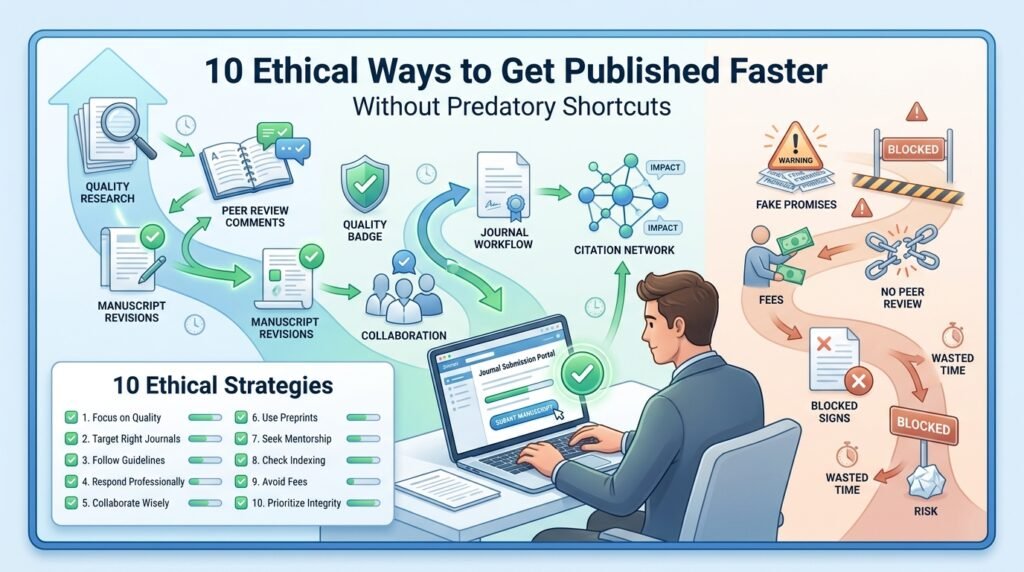
10 Ethical Ways to Get Published Faster (Without Predatory Shortcuts)
Here’s the uncomfortable arithmetic of publication speed: the part you can’t control — peer review — typically takes 8–18 weeks per decision, while the parts you can control routinely waste more time than that. Wrong-journal submissions burn full review cycles; formatting failures trigger administrative bounces; slow revisions add months. Every item below attacks controllable time, and none of them is a shortcut through quality — because the fake accelerators (guaranteed-acceptance journals, 72-hour “review”) cost more time than they save when the publication turns out to be worthless. If a tactic ever smells like that, run it through our predatory journal checklist first.
The two clocks
Every manuscript runs on two clocks. The journal’s clock — desk decision, review rounds, production — is institutional time you influence only indirectly. The author’s clock — selection, formatting, revision turnaround, and every detour — is entirely yours, and in real pipelines it routinely accounts for as much delay as review does. The ten tactics below sort cleanly by clock: #1–#5 stop you from donating months to the journal’s clock unnecessarily; #6–#8 make the journal’s clock run as fast as it honestly can; #9–#10 compress the author’s clock directly. Read the summary table at the end with that lens and the leverage map becomes obvious.
1. Choose for scope fit, not prestige order
The single biggest self-inflicted delay is the aspirational-first submission ladder: shoot for the top journal regardless of fit, absorb a 3–4 month rejection, repeat. Every wrong-scope submission costs a full cycle. The faster strategy: target the best journal whose recent tables of contents actually host your conversation — fit drives both acceptance odds and review speed, because in-scope papers find willing reviewers faster.
2. Check review-speed data before you commit
Journals increasingly publish their own timeline statistics — average time to first decision, submission-to-acceptance — on their homepages, and publisher journal-finder tools expose them side by side. Between two suitable journals, weeks of median difference are common. Ten minutes of comparison here buys months later. Caveat: treat self-reported averages as estimates, and ultra-fast claims as a red flag, not a feature.
3. Format to the author guidelines the first time
High-volume journals bounce non-compliant submissions administratively — wrong reference style, over-limit word counts, missing declarations — before any editor reads them, and each bounce-and-resubmit loop costs one to three weeks. The fix costs an afternoon: format to the guidelines, complete every declaration, and run the journal’s own submission checklist before you upload.
4. Use pre-submission inquiries where offered
Many journals accept a short pre-submission inquiry — abstract plus a paragraph on fit — answered by an editor in days. A “not for us” by email costs a week; the same answer by desk rejection costs a month or more. Where the option exists (check the author guidelines), it is the cheapest scope test in publishing. Keep it short: editors answer two paragraphs, not attachments.
5. Write the cover letter editors actually read
The cover letter’s job is triage assistance: what the paper shows, why it fits this journal, what’s new against the two closest recent papers in it — half a page, no manuscript summary, no flattery. Editors making rapid desk decisions use it to route papers to review faster; a generic letter wastes the one document guaranteed to be read first.
6. Post a preprint — after checking policy
Preprints (SSRN, arXiv, and disciplinary servers) make your work citable and visible during the review wait — establishing priority on your contribution while the journal deliberates. Most major publishers now permit preprinting; a minority of journals still restrict it. The rule: check the journal’s preprint policy (their guidelines or the publisher’s policy pages state it) before posting, and disclose the preprint at submission. Done in that order, it’s free speed for your ideas, if not for the acceptance itself.
7. Treat special issues as an opportunity — with screening
Legitimate special issues can run faster than regular streams: motivated guest editors, committed reviewer pools, fixed timelines. But the special-issue format is also the most abused corner of open access publishing, and indexers have delisted high-volume offenders. Screen the issue like a journal: verifiable guest editors with standing in the topic, the parent journal’s indexing current at source, review process stated. Pass, and it’s a genuine accelerator; fail, and see our checklist post.
8. Make your manuscript effortless to review
Review speed partly reflects reviewer friction. Papers that state the contribution in one sentence, report completely (per field standards), number their hypotheses, label their tables self-sufficiently, and write limitations honestly get reviewed faster and rounder — reviewers reciprocate effort. Professional editing serves speed here, not just correctness: clean prose shortens every reader’s job, and an editing certificate answers language concerns before they’re raised.
9. Respond to revisions fast, complete, and once
The revision window is the most controllable interval in the whole timeline — typical windows run 4–12 weeks, and authors routinely use all of it for changes that need three. Triage the comments on day one, request any extension early (not at the deadline), answer every point with locations, and aim to give the editor grounds to accept without a second external round. A complete first response is the difference between one more month and four. Our reviewer-response guide covers the letter itself.
10. Parallelize the pipeline, not the paper
The one legitimate answer to review-wait frustration is a portfolio: while paper A sits in review, paper B is in revision and paper C in drafting — the thesis-to-articles pathway naturally feeds this. What is never legitimate is parallel submission of the same paper to multiple journals: dual submission is a named ethics violation at effectively every journal, gets detected via reviewer overlap and integrity software, and can burn your standing with two editors at once. Speed comes from more shots in sequence across papers — never from duplicating one.
What it looks like in practice: two timelines
An illustrative composite from the patterns we see in client work — numbers are typical, not promises. Author A finishes a manuscript in January and submits aspirationally to a poor-fit flagship: desk rejection in week 3. Resubmits the identical file to a second journal: full review, rejection on scope-adjacent grounds in week 19. Third journal, minor formatting bounce (week 21), then review, major revision (week 34), a slow eleven-week revision using the full window plus an extension, second decision week 52. Acceptance: month 14. Author B runs the two-week protocol from our rejection-reasons post, pre-checks scope with a two-paragraph inquiry (answered in four days), submits once to a fit-matched journal with published timeline data: first decision week 12, major revision triaged on day one and returned in five weeks, accepted at week 22. Same quality of underlying research; seven months of difference — all of it from the controllable clock.
What never speeds you up (the myth list)
- Duplicate submission — covered in #10, worth repeating: a named ethics violation, increasingly auto-detected, capable of burning two journals at once.
- Salami-slicing one study into fragments — editors recognize least-publishable units on sight; thin papers reject slower than substantial ones accept, and the practice flags your name.
- Suggesting friendly reviewers dishonestly — recommended-reviewer fraud (fake emails, undisclosed collaborators) is a retraction-level offense that integrity teams now screen for systematically.
- Citation padding toward the journal — gratuitous self-citation of the target journal to flatter metrics is transparent, sometimes flagged, and never the reason a paper is accepted.
- Deadline-driven journal downgrades to unverified outlets — the predatory funnel’s favorite entrance; an unusable publication is the slowest possible outcome, because the work can’t be republished honestly.
Where the time actually goes
| Interval | Typical duration | Your leverage |
| Journal selection & formatting | 1–3 weeks (often skipped, then repaid with interest) | Total — items #1–#3 |
| Desk decision | 1–4 weeks | Indirect — items #1, #3, #5 |
| First review round | 8–18 weeks | Indirect — items #2, #7, #8 |
| Your revision | 4–12 week window | Total — item #9 |
| Second decision | 4–8 weeks | Indirect — the completeness of #9 |
| Wrong-journal detour | +3–6 months per occurrence | Total — this is the one to eliminate |
What “fast” honestly means, by venue type
Calibrate expectations before optimizing. Sound-science megajournals and well-run special issues at reputable publishers often return first decisions toward the lower end of the 8–18 week band, and some publish median times under three months submission-to-acceptance. Selective disciplinary journals in business and social science commonly run toward the upper end, with total submission-to-acceptance spans of six months to a year even for successful papers. Humanities-adjacent fields run longer still. Any venue promising decisions in days sits outside the honest distribution entirely — that’s not a fast journal, it’s a fake one. The realistic optimization target is not beating the distribution; it’s reaching its favorable end and refusing to donate extra months through the author’s clock.
The extension email (copyable)
Since item #9 turns on requesting extensions early, here is the entire email: “Dear Dr. [Editor], — Thank you for the opportunity to revise manuscript [ID]. Addressing Reviewer 2’s request for [specific work, e.g., the additional robustness analysis] will require approximately [N] additional weeks beyond the current deadline of [date]. Would an extension to [specific date] be acceptable? All other revisions are complete. — [Name]” Three sentences, one specific date, sent the week you triage — not the week the deadline lands. Editors grant these routinely; what they penalize is silence.
The takeaway
Publication speed is won on the author’s clock and defended on the journal’s. Choose for fit, verify timelines, format once, ask before submitting where journals allow it, write the letter editors read, preprint within policy, screen special issues, reduce reviewer friction, revise fast and completely, and build a portfolio instead of duplicating a paper. None of it is a shortcut; all of it compounds — and the compound difference, as the two timelines above show, is measured in months per paper and years per career.
FAQs
Do paid “fast-track” options at legitimate journals count as ethical? A few reputable publishers offer paid expedited review under disclosed, formalized terms — controversial but transparent. Distinguish that sharply from journals whose entire model is speed-for-payment: the disclosed fast lane at a real journal is a judgment call; the 72-hour journal is a scam.
Can contacting the editor speed things up? A polite status inquiry after the journal’s stated review period (not before) is normal and occasionally dislodges a stalled review. Weekly emails achieve the opposite.
I need an accepted paper before my viva — what’s realistic? Work backwards: 8–18 weeks to first decision, a revision round, a second decision — realistically 6–12 months from submission to acceptance at an honest journal. Start earlier than feels necessary, use every controllable accelerator above, and target journals with published timelines that fit your date. What you should never do is let the deadline hand you to a predatory journal — an unusable publication misses the deadline and wastes the paper.
Are megajournals a legitimate speed option? Broad-scope, soundness-based journals from reputable publishers review for methodological validity rather than novelty judgments, which often shortens decisions — and many are properly indexed. Check three things against your requirement: current indexing at source, your committee’s view of the venue, and the APC. Legitimate speed, provided the venue satisfies the rule you’re publishing under.
Does open access publishing speed anything up? OA affects visibility after acceptance, not review speed before it — review runs on the same referees either way. Where OA helps the clock is dissemination: your accepted paper is readable and citable immediately, with no paywall lag. Choose OA on requirements and budget, not as a review accelerator.