
 thesiswriter.pk@gmail.com |
  +92 3164838761
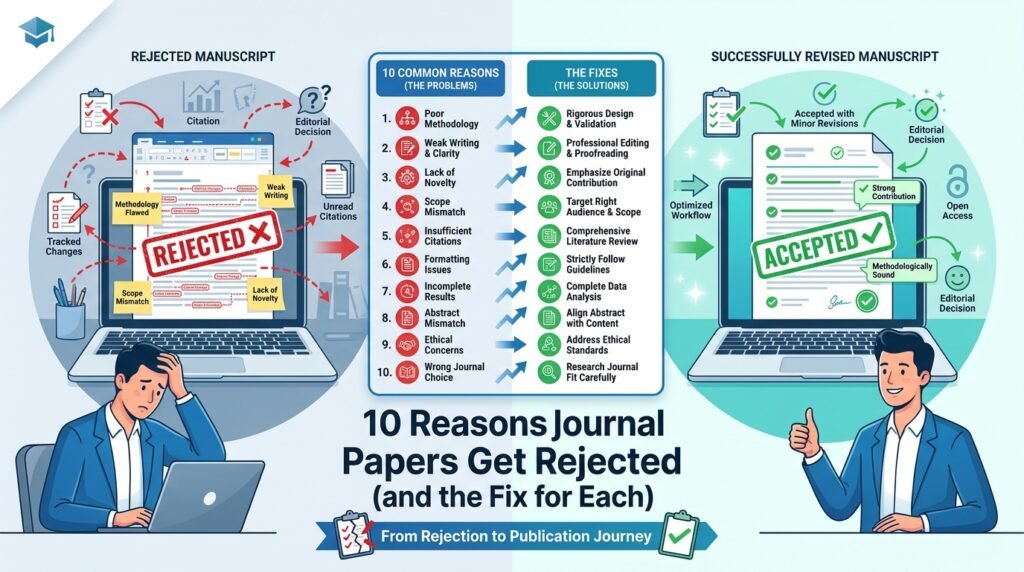
10 Reasons Journal Papers Get Rejected — and How to Fix Each One
Rejection is the statistical norm of academic publishing, not a verdict on your ability. Desk rejection alone — removal before peer review — runs anywhere from 15% to 90% of submissions at individual journals, and overall acceptance rates at selective titles commonly sit between 10% and 40%. The encouraging part: rejection reasons are remarkably repetitive. Editors and editorial studies keep listing the same failures, which means most rejections are preventable with the checklist below. Each item ends with the fix.
What the data pattern tells you before we start
Two facts should reframe how you read this list. First, rejection is front-loaded: at many journals the desk stage — an editor’s read of days, sometimes hours — removes more manuscripts than peer review does, and desk rejections cluster overwhelmingly around fit and formality failures (#1, #6, #8) that cost nothing to prevent. Second, each cycle is expensive in calendar terms: a desk rejection costs one to four weeks, but a post-review rejection costs the full 8–18 week wait plus your invested hope, and a wrong-journal detour typically burns three to six months end to end. Multiply that by the two-to-four submissions an average published paper survives, and prevention stops being perfectionism — it’s the only timeline strategy that works. Editorial studies across fields keep converging on the same short list of causes, which is exactly why a checklist approach beats talent: the failure modes are known, named, and individually cheap to fix.
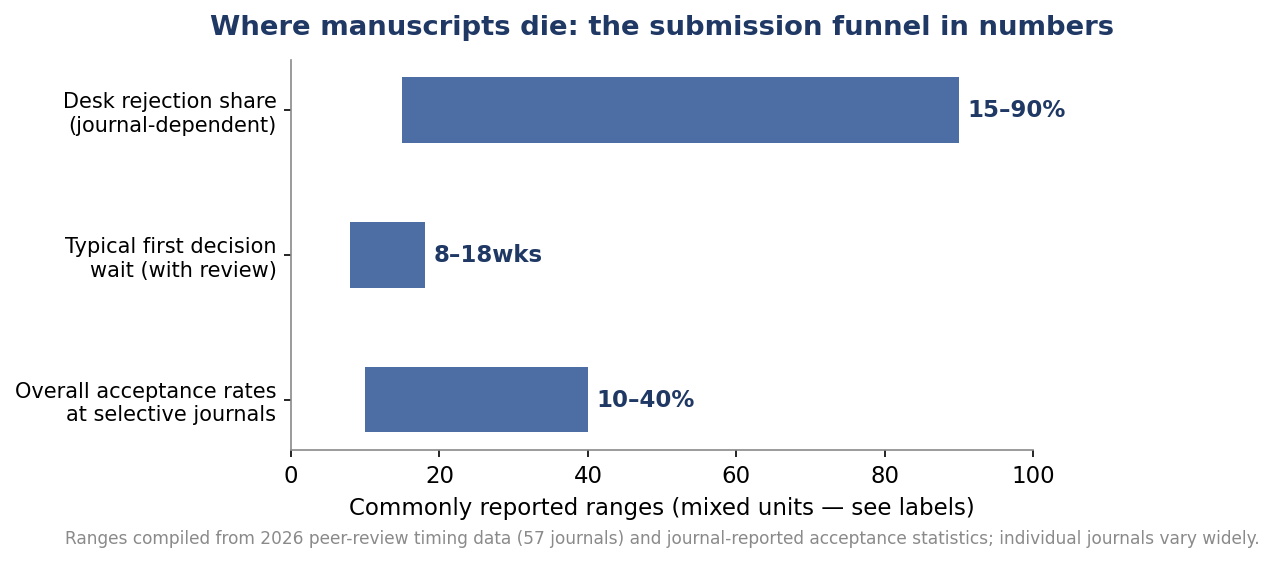
Figure 1. The submission funnel. Most losses happen for the predictable reasons listed below.
1. Out of scope for the journal
The most common desk-rejection reason in editors’ own accounts — and the most avoidable. A methodologically sound paper sent to a journal whose readers don’t care about the question wastes everyone’s time, and editors protect reviewers from it ruthlessly. The tell: your citation list barely features the target journal. Fix: read the aims-and-scope page and the last two years of tables of contents; if the journal hasn’t published your conversation, it won’t start with you. Our journal selection guide covers the matching process in depth.
2. The contribution is unclear
“What does this add?” is the question every editor asks by the end of your abstract — and “the contribution is not clear” is arguably the most common substantive reviewer comment in existence. Papers that summarize a gap without stating a claim die here. Fix: write the one-sentence test before anything else — “This paper shows that ___, which matters because ___” — and make sure the abstract, the final introduction paragraph, and the discussion all deliver that same sentence.
3. Methodological weaknesses
The dominant post-review rejection reason: inadequate sample for the claims, missing controls, inappropriate tests, unvalidated instruments, or analysis that doesn’t match the research question. Unlike scope, this can be fatal after months of review — which is why it deserves referee-standard eyes before submission. Fix: match the analysis to the question explicitly (our statistical test chooser helps), report assumption checks, and justify sample size rather than hoping nobody asks. If a design flaw is real, honest limitations plus tempered claims beat overclaiming every time.
4. Incomplete or non-transparent reporting
Reviewers can’t approve what they can’t verify. Missing descriptive statistics, unreported response rates, absent reliability coefficients, vague procedure descriptions, and unavailable instruments all convert “accept with revisions” into “reject.” Fix: report to your field’s standard — CONSORT, PRISMA, or the APA Journal Article Reporting Standards — and include the boring tables. Completeness reads as competence.
5. Outdated or thin literature engagement
A literature review that stops eighteen months ago tells referees the manuscript sat in a drawer — a common fate of thesis-derived papers. So does citing only classic sources while ignoring the journal’s own recent conversation. Fix: run a targeted update on your key journals in the final month before submission, and engage the newest relevant work substantively, not decoratively.
6. Language and presentation problems
Editors insist language alone rarely rejects a strong paper — but language problems amplify every other weakness, because a reviewer fighting your sentences has no patience left for your argument. Studies of rejection feedback consistently list poor writing among the recurring factors. Fix: professional English editing before submission (with an editing certificate where journals request one), or at minimum a cold read by a fluent colleague. This is the cheapest acceptance-odds upgrade available.
7. Overclaiming
Cross-sectional data presented as causal findings; a single-country sample generalized to humanity; “proves” where “suggests” belongs. Reviewers treat overclaiming as a credibility signal about everything else in the paper. Fix: calibrate every claim to your design, own your limitations before reviewers do, and let implications be conditional. Understated papers survive review; oversold ones get made examples of.
8. Journal-fit formalities ignored
Wrong reference style, word count 40% over the limit, missing declarations, figures in the wrong format, no data availability statement. Individually trivial — collectively they signal carelessness, and at high-volume journals they trigger administrative desk rejection before any editor reads a word. Fix: format to the author guidelines before submission, not after acceptance; it’s an afternoon that protects months.
9. Ethics gaps
Missing ethics approval statements, absent consent procedures, undeclared conflicts of interest, or unexplained image and data anomalies. Post-pandemic editorial screening is stricter than ever, and integrity software now runs before human review at many publishers. Fix: state approvals and consent explicitly, declare everything declarable, and keep raw data ready to share — the request is increasingly standard.
10. Wrong response to a previous rejection
Resubmitting a rejected paper unchanged to the next journal down the list is the silent killer of publication timelines — the same weaknesses meet the same objections, sometimes the same reviewer. Fix: treat every rejection’s reviews as free consulting. Fix what’s right, document what you changed, and re-target on scope, not just rank. Our resubmission support exists for exactly this loop.
Bonus: reading the rejection letter correctly
Not all rejections are the same document, and misreading them causes reason #10. A hard reject (“not suitable for this journal”) closes that door — take the reviews and re-target. A reject-and-resubmit invites a substantially reworked version back — it is a slower revise-and-resubmit, not a no. A transfer offer — increasingly common at large publishers — proposes moving your manuscript, sometimes with its reviews attached, to a sister journal; evaluate the destination on its own merits (scope, indexing, APC) exactly as you would a fresh target, because cascade journals range from excellent to expedient. And any rejection accompanied by substantive reviews is, whatever it feels like, free consulting from experts in your field: the correct response to all four types is extraction of value, not resubmission of the identical PDF.
The two-week rejection-proofing protocol
Here’s how the ten reasons become a pre-submission workflow. Days 1–2: run the one-sentence contribution test and rewrite the abstract until it passes (#2), then check scope against the target journal’s last two years (#1). Days 3–5: reporting audit against your field’s standard — every instrument, coefficient, and procedure verifiable (#4) — and a claims pass calibrating language to design (#7). Days 6–8: literature update on your key journals (#5); integrate, don’t decorate. Days 9–10: methods self-review or, better, referee-standard external eyes (#3). Days 11–12: professional language pass (#6). Days 13–14: author-guideline formatting, declarations, ethics statements, and the journal’s own checklist (#8, #9). Two weeks against a three-to-six-month detour is the best trade in academic publishing.
The pattern behind all ten
| Stage where it kills you | Reasons | Prevention |
| Desk (days 1–28) | #1 scope, #8 formalities, #6 language (severe cases) | Journal matching + guideline formatting + editing |
| Review (weeks 8–18) | #2 contribution, #3 methods, #4 reporting, #5 literature, #7 overclaiming, #9 ethics | Pre-submission peer review catches these before referees do |
| After rejection | #10 unchanged resubmission | Structured revision + re-targeting |
Every reason on this list is visible before submission — to someone reading with referee eyes. That is the entire logic of pre-submission review: hear it from a friendly reviewer while it costs days, not from Reviewer 2 when it costs a year.
How the reasons compound
The ten reasons rarely arrive alone, and their interactions explain the harshest outcomes. Language problems (#6) make methodological explanations read weaker than they are, converting a fixable #3 into a fatal one. An unclear contribution (#2) makes reviewers hunt for a reason the paper exists, and a hunt through outdated literature (#5) or overclaimed findings (#7) always finds one. Formality failures (#8) prime the desk editor to read everything else uncharitably. The compounding works in reverse, too: a crisp contribution statement buys patience for imperfect methods, and complete reporting (#4) converts reviewer suspicion into reviewer suggestions. Practical consequence: fix the cheap universal amplifiers first — clarity, completeness, formatting — because they change how every substantive element is judged.
From list to habit: the one-page submission checklist
Condense this post to a checklist you run on every future manuscript: scope verified against two years of the target’s contents · one-sentence contribution present in abstract, introduction, and discussion · analysis matched to question with assumptions reported · reporting complete to field standard · literature current to within months · professional language pass done · claims calibrated to design · author guidelines and declarations complete · ethics statements explicit · and, if this is a resubmission anywhere, a documented change log against the previous reviews. Ten lines, two weeks maximum, and every one of them is cheaper than the rejection it prevents.
The takeaway
Rejection is a system with known failure modes, and systems reward preparation over talent. Editors are not adversaries hunting reasons to reject — they are triage officers protecting scarce reviewer hours, and every item on this list is a signal they use to predict whether review time will be well spent. Send the signal deliberately: matched scope, stated contribution, verifiable methods, complete reporting, current literature, clean language, calibrated claims, compliant formatting, explicit ethics, and evidence of learning from any previous round. Do that, and rejection stops being a lottery and becomes what it should be — an occasional, informative event on the way to acceptance rather than the defining experience of your publishing life.
FAQs
Is rejection ever just bad luck? Sometimes — reviewer lotteries are real, and good papers bounce. But “bad luck” explains single rejections, not patterns. Two rejections citing similar issues is data; treat it as such.
Should I appeal a rejection? Only for demonstrable factual error in the decision, and rarely even then — appeals succeed at low rates and cost weeks. Re-targeting with improvements is almost always the faster route to print.
How many rejections is normal? Multiple. With selective-journal acceptance commonly in the 10–40% band, two to four submissions per published paper is unremarkable across fields. Plan timelines accordingly — especially against graduation deadlines.
Do rejection rates differ by field? Substantially — flagship journals in management and psychology commonly report acceptance under 10–15%, while sound-science megajournals accept methodologically solid work at far higher rates by design. Which is one more argument for choosing journals on requirements and fit rather than folklore prestige.
Does a cover letter really affect desk decisions? At busy journals, yes — it’s often the first document opened. A half-page stating the contribution, the fit, and the two closest recent papers in the journal helps an editor route you to review instead of reaching for the scope-rejection template. A generic letter squanders the one guaranteed read.