
 thesiswriter.pk@gmail.com |
  +92 3164838761
Scopus vs Web of Science: What’s the Difference and Which Do You Need?
Short answer: Scopus (Elsevier) indexes roughly 27,000–28,000 active peer-reviewed journals; the Web of Science Core Collection (Clarivate) indexes about 21,000–22,000 and is more selective. Scopus gives you broader coverage plus the CiteScore, SJR, and SNIP metrics; Web of Science is the only source of the Journal Impact Factor. Which one you need depends on exactly one thing: what your university, scholarship, or promotion committee requires in writing. This guide covers the differences that actually change decisions — coverage, metrics, quartiles, the ESCI trap, and delisting risk — with verification steps at the end.
What each database actually is
Both are abstract-and-citation databases: they don’t publish anything themselves, but they decide which journals “count” for most of the world’s universities, and they generate the citation metrics careers are measured with. When your regulations say “publish in an indexed journal,” one of these two databases is almost always the referee.
Web of Science is the older system by decades. Its lineage runs back to Eugene Garfield’s Science Citation Index, launched in 1964 by the Institute for Scientific Information — the “ISI” that still appears in university requirement documents across Saudi Arabia, Malaysia, and the UAE. Today it’s owned by Clarivate, its citation records reach back to 1900, and its Core Collection is split into the sub-indexes you’ll see named in regulations: SCIE (sciences), SSCI (social sciences), AHCI (arts and humanities), and ESCI (emerging sources). Those distinctions matter more than most researchers realize — more on the ESCI trap below.
Scopus launched in 2004 as Elsevier’s answer to Web of Science, built deliberately broader: more journals, more non-English titles, more coverage of journals from developing research systems, with citation data from 1970 onward. That inclusiveness is precisely why Scopus became the default requirement across much of Asia and the Gulf — it recognizes more of the journals researchers in those regions actually publish in.
Coverage: the numbers
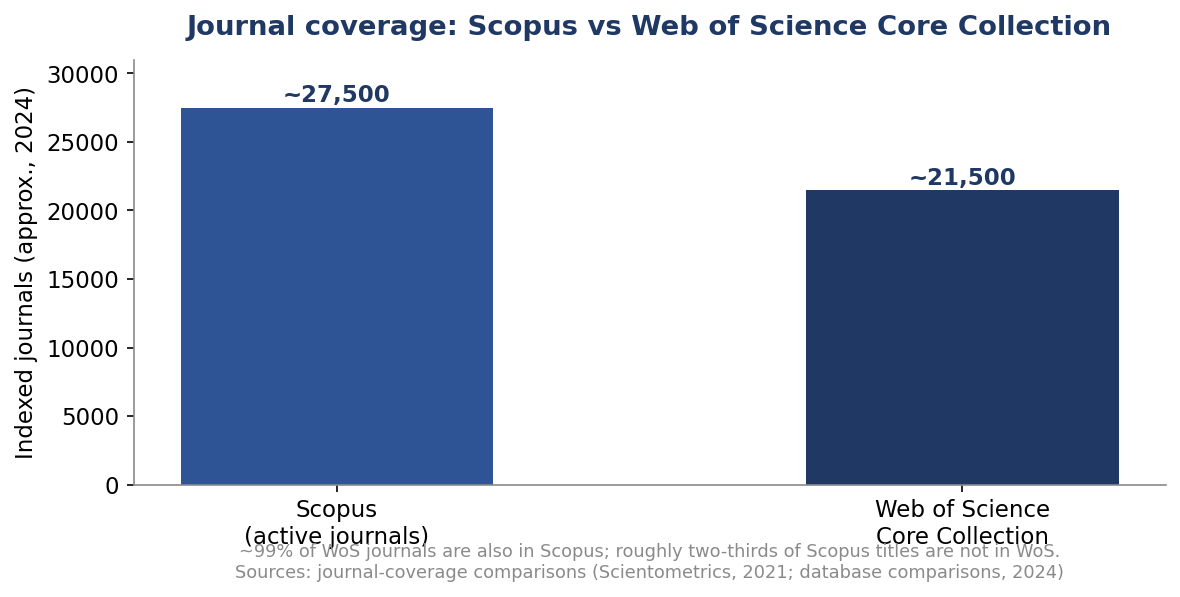
Figure 1. Approximate active journal coverage, 2024 comparisons. Scopus covers roughly 25–30% more journals than the WoS Core Collection.
The headline gap — roughly 27,000–28,000 active Scopus journals versus 21,000–22,000 in the WoS Core Collection — understates the practical difference, because the overlap is asymmetric. Journal-coverage studies published in Scientometrics found that around 99% of Web of Science journals are also indexed in Scopus, while about two-thirds of Scopus titles are not covered by Web of Science at all. The practical rule that falls out of this: a WoS-indexed journal almost always satisfies a Scopus requirement, but a Scopus-indexed journal frequently fails a WoS requirement. When in doubt, target the stricter standard.
The comparison table
| Factor | Scopus | Web of Science Core Collection |
| Active journals indexed | ≈27,000–28,000 | ≈21,000–22,000 |
| Owner | Elsevier | Clarivate |
| Citation coverage from | 1970 | 1900 |
| Journal metrics | CiteScore, SJR, SNIP | Journal Impact Factor (JIF), via JCR |
| Quartiles | CiteScore/SJR quartiles | JIF quartiles (JCR) |
| Sub-index structure | Single list + subject areas | SCIE / SSCI / AHCI / ESCI tiers |
| Selectivity | Broader, more inclusive | More selective at Core level |
| Common requirement in | Malaysia, Gulf states, much of Asia | “ISI”/JIF-based promotion files; STEM |
| Overlap | Indexes ~99% of WoS journals | ≈66% of Scopus titles NOT in WoS |
| Free verification tool | Scopus Sources list | Clarivate Master Journal List |
Metrics and quartiles: JIF vs CiteScore
The two databases run separate metric systems, and they are not interchangeable. The Journal Impact Factor exists only for journals in SCIE and SSCI, is calculated by Clarivate from Web of Science citations, and is published annually in the Journal Citation Reports — the June 2026 JCR release covers around 22,600 journals. CiteScore is Scopus’s equivalent, calculated over a four-year window instead of two, from a different citation pool. The same journal routinely lands in different quartiles under the two systems: Q2 by JIF and Q1 by CiteScore is common, because CiteScore quartiles are computed against Scopus’s larger, broader journal set.
That has a sharp practical consequence: if your promotion criteria say “Q1 journal,” find out which system defines the quartile before you choose a target. A journal’s marketing will always quote whichever quartile flatters it.
The ESCI trap
The single most common indexing mistake we see in manuscript assessments: a researcher needs an “ISI journal with an impact factor,” finds a journal listed in Web of Science, submits, publishes — and then discovers the journal sits in ESCI, the Emerging Sources Citation Index. ESCI journals are genuinely part of the Web of Science Core Collection, but historically they did not receive a Journal Impact Factor, and many institutional requirements written around JIF still exclude them. Whether your institution accepts ESCI is a question to settle in writing before you submit, not after you publish. The Master Journal List shows exactly which index a journal occupies — check the index name, not just the “Web of Science” badge.
A note on “ISI” — and a warning
“ISI-indexed” in a 2026 requirement document means Web of Science, and usually SCIE or SSCI specifically. But the obsolete name has a second life in the predatory-journal economy: fake metrics providers sell “ISI impact factors” to journals that appear in neither database. If a journal advertises an ISI impact factor from any source other than Clarivate’s Journal Citation Reports, treat it as disqualifying — and run the journal through our predatory journal checklist before going anywhere near its submission system.
Delisting: the risk nobody mentions
Indexing is not permanent. Scopus re-evaluates titles continuously and discontinues journals for publication-ethics concerns and quality collapse — discontinued titles are listed in the Scopus source list updates, and the crucial detail is that articles published after the discontinuation date don’t count as Scopus-indexed. The same manuscript, in the same journal, can be a valid publication in March and an unindexed one in September. Before submitting to any journal — especially a fast-growing open access title — check its current status and its trajectory, not a screenshot from two years ago.
Which one do you need? Three scenarios
| Your situation | What to target | Why |
| Malaysian doctoral candidate (publish-to-graduate rule) | Scopus-indexed as floor; check if WoS or MyCite also accepted | Most Malaysian graduation requirements name Scopus explicitly |
| Faculty promotion file citing “ISI” or JIF | SCIE/SSCI journals with a current JIF; confirm quartile system | ESCI and Scopus-only titles typically don’t satisfy JIF-based criteria |
| Building an international CV (no fixed rule) | Journals indexed in both, best scope fit first | Dual indexing maximizes recognition; fit drives acceptance odds |
How to verify (5 minutes, at the source)
- Web of Science: search Clarivate’s free Master Journal List; record which index (SCIE/SSCI/AHCI/ESCI) the journal sits in — screenshot it for your records.
- Scopus: download or search the current Scopus Sources list; confirm the title is active, not discontinued.
- Impact Factor claims: verify in Journal Citation Reports (or the journal’s Clarivate profile) — never from the journal’s own website.
- Malaysia: cross-check MyCite/MyJurnal where local indexing satisfies part of your requirement.
- Keep evidence: indexing status at the date of your submission is worth documenting — it protects you if a journal is later delisted.
What about Google Scholar, Dimensions, and the rest?
Researchers often ask why the conversation stops at these two databases when Google Scholar finds everything and newer indexes like Dimensions and OpenAlex cover far more journals — coverage studies show Dimensions indexing dramatically more titles than either Scopus or WoS. The answer is gatekeeping: those systems index inclusively by design, which makes them excellent for literature discovery and hopeless as quality signals. No serious graduation or promotion requirement is written against “indexed in Google Scholar” — and any journal advertising Google Scholar or ResearchGate as its “indexing” is telling you it has none that counts. Use the broad indexes to find literature; use Scopus and Web of Science to choose where to publish.
How the two databases decide who gets in
Understanding the gatekeeping explains the coverage gap. Web of Science evaluates journals against a two-stage framework: a set of quality criteria covering peer review practice, editorial rigor, ethics policies, and publishing standards — journals meeting these enter ESCI — and a further set of impact criteria measuring citation influence, which promote a journal into SCIE or SSCI. That tiered design is why “in Web of Science” is ambiguous and why the ESCI distinction matters. Scopus evaluation runs through its Content Selection & Advisory Board, an international group of subject experts reviewing titles against criteria that include convincing peer review, publication ethics, citedness, regularity of publication, and content quality — rigorous, but calibrated for inclusiveness rather than tiering. The result: Scopus admits more of the world’s credible journals; Web of Science ranks harder within the ones it admits. Neither approach is “better” — they answer different questions, which is why requirements name one or the other.
What you can check for free
Both databases sell subscriptions, but the verification layer — the part you need — is free. Clarivate’s Master Journal List is openly searchable and shows a journal’s exact index. Elsevier publishes the Scopus source list as a downloadable file, updated during the year, including the discontinued-titles tab that most researchers never open and absolutely should. Journal-level metrics are also visible without subscription: CiteScore appears on every journal’s public Scopus source page, and many publishers display their JCR-verified Impact Factor with a Clarivate attribution you can cross-check. If a verification step ever seems to require paying the journal or a third-party “indexing agency,” you’ve left the legitimate ecosystem.
Regional notes for our readers
- Malaysia: graduation requirements at research universities typically specify Scopus or WoS for doctoral publication conditions, with MyCite-indexed Malaysian journals accepted for some programs and purposes — read your faculty’s wording precisely, because “indexed journal” and “Scopus-indexed journal” are different sentences.
- Saudi Arabia & UAE: promotion frameworks commonly reference “ISI” — read as SCIE/SSCI with a current JIF — and increasingly accept Scopus with quartile conditions. Confirm which quartile system (JCR or CiteScore) your committee applies before targeting.
- UK: REF-era assessment reads outputs on originality, significance and rigour rather than database membership — but hiring and grant committees still read CVs through journal recognition, so indexing remains practically relevant.
FAQs
Is Scopus easier to publish in than Web of Science? Neither database publishes anything — difficulty belongs to individual journals. Scopus indexes more journals, including more accessible ones, so the floor is lower; but a top Scopus journal is exactly as hard as its WoS twin, because it usually is its WoS twin.
Can a journal lose its Impact Factor? Yes — Clarivate suppresses or delists titles for citation manipulation and ethics failures. Another reason to check current-year status.
My field’s best journals are only in Scopus. Is that a problem? Only if your requirement says WoS. In many applied and regional fields, Scopus-only journals are the legitimate mainstream — requirements, not prestige folklore, should drive the call.
Why is my h-index different in Scopus and Web of Science? Each database counts only citations from sources it indexes. Scopus’s larger source pool usually yields a higher h-index than WoS for the same person; Google Scholar, indexing the open web, runs higher still. Always label which database a metric comes from — mixing them misleads committees and reviewers alike.
Do conference papers count? Both databases index selected conference proceedings (WoS through its proceedings citation indexes; Scopus extensively in computing and engineering). Whether proceedings satisfy your requirement is again a wording question — many promotion rules count only journal articles.